Multi-duct pull in Telecom Corridor
Richardson-adjacent builds pull bundled HDPE with Oncor and fiber congestion in the first four feet. Potholing confirms depth before pull — speed without locates fails on chalk-heavy ROW.
Dallas, TX · Dallas County
Fiber and telecom conduit along Dallas US-75, Preston Road, and Telecom Corridor — multi-duct HDPE with Oncor remark tickets through shallow subdivision stacks.
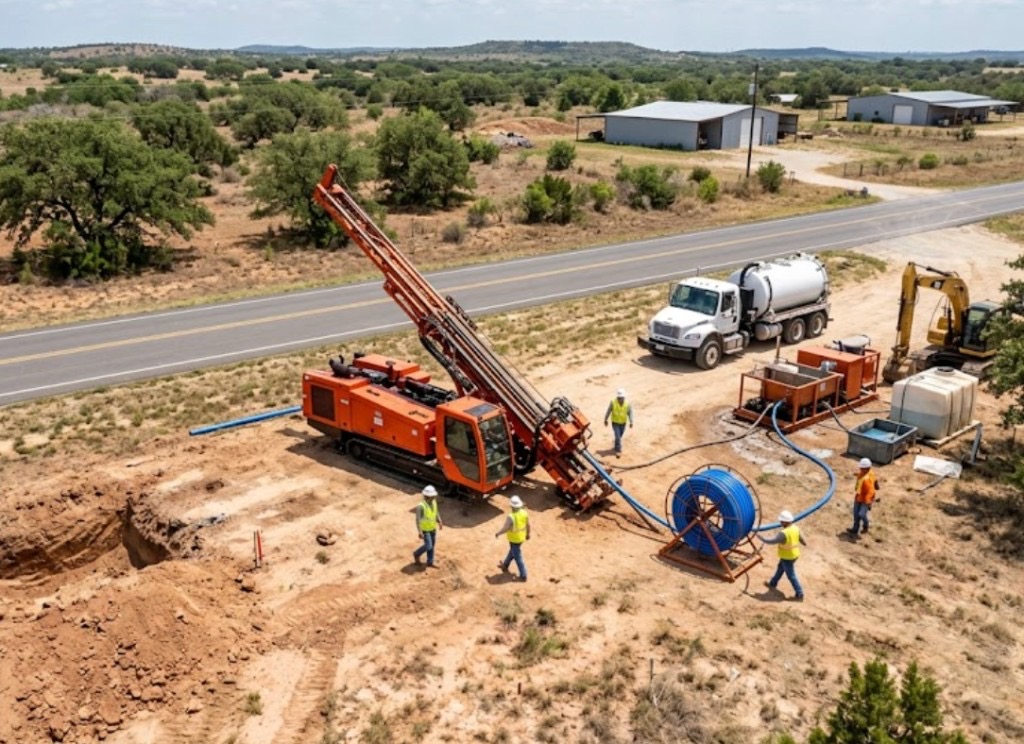
Fiber optic boring in Dallas supports data-center backhaul, 5G small cells, and enterprise conduit along the Telecom Corridor and north tollway growth band. US-75, I-635, and Preston Road stack shallow Oncor secondary, irrigation, and private fiber — remark tickets and hand holes at conflicts are standard.
Directional Boring Texas places HDPE duct bundles under sidewalks, medians, and Far North Dallas landscape easements with HDD sized for conduit count. Vault ties are planned where 811 paint cannot show the full shallow utility picture under chalk and clay.
Real Dallas County angles — not generic statewide copy.
Richardson-adjacent builds pull bundled HDPE with Oncor and fiber congestion in the first four feet. Potholing confirms depth before pull — speed without locates fails on chalk-heavy ROW.
Dense commercial blocks need short vault-to-pole shots without shutting restaurant frontage. Compact pits protect pavers and granite curbs.
Multi-building campuses want redundant rings under drives and landscape islands. HDD links hand holes with minimal sod damage — irrigation conflicts surprise many north Dallas sites.
Highway widening relocations place telecom with water and electric moves. Sequencing with prime contractors avoids paths that fight Mixmaster lane-shift schedules.
Conduit count and bend radius define profile. Entry pits preserve curb returns on granite-edged ROW. Pullback bundles HDPE — chalk stringers can increase reamer wear on some north Dallas pulls.
Expansive Austin Chalk and Eagle Ford shale intervals, black clay, and shallow rock influence bore stability across Dallas County.
Dallas bores commonly hit expansive clay with Austin Chalk and shale stringers. Clay-heavy profiles need careful mud rheology to avoid frac-outs toward storm drains and creeks. Shallow rock can shorten steer time but increase wear on reamers — production estimates reflect that. East Dallas sandier pockets near the Trinity are less common but change fluid loss behavior. We review as-built utilities from Dallas Water Utilities and Oncor maps where available to avoid revisiting known congested intersections.
Blackland prairie thunderstorms, hail season, and summer heat drive restoration timing and when asphalt patches can be placed.
Spring hail and thunderstorms can pause outdoor work for safety. Summer heat restricts asphalt restoration windows — patches need proper compaction temperature. Winter ice storms drive emergency water line demand; frozen soil can slow pit excavation but rarely stops HDD once pits are open.
City of Dallas Public Works, Dallas County, NCTCOG corridors, DART adjacency, and TxDOT Dallas District on state routes.
City of Dallas ROW permits cover street cuts and bore notifications. Dallas County handles pockets outside city limits. DART coordination is mandatory within rail influence. TxDOT Dallas District permits state highway work — US-75 and I-635 crossings are frequent on telecom and water trunk relocations. Oak Cliff and Bishop Arts districts may have additional streetscape standards for restoration color and texture.
Trenching across Uptown entries and Knox Street medians triggers expensive paver restoration. Fiber boring keeps storefronts open on McKinney and Cedar Springs corridors.
Duct count, bore length, soil, hardscape restoration at vaults, traffic control, and permit fees in city ROW.
We review plans, bore path, access, existing utilities, and owner goals — residential repair or engineered crossing.
Texas dig law compliance: ticket, wait period, verify marks, pothole at conflicts before steel or bit enters ground.
Alignment, profile, soil expectations, permit needs, and crossing agreements for roads, rails, or waterways.
Right rig for length and diameter — mini-HDD for tight urban shots, larger spreads for long pulls and reams.
Steerable pilot, survey checks, reaming passes as required for product pipe or casing diameter.
HDPE fusion, steel casing, conduit bundles, or carrier pipe installed per spec with pullback monitoring.
Alignment records, mandrel or pressure tests where spec requires, as-built for owners and inspectors.
Minimal surface disturbance philosophy — compact entry/exit pits, restore hardscape and landscape per scope.
Depends on OD, bend radius, and ream diameter — Telecom Corridor multi-duct backhaul is common.
Yes — electric conflicts are standard on arterials. Locates, remarks, and potholing at stacked utilities are in scope.
Yes — pits offset to preserve concrete and pavers except at vault ties.
Shallow stacks, hail delays, TxDOT MOT, and DART flagging — built into schedules.
Duct count, length, chalk, congestion, night work, and paver restoration drive price — provide path for estimate.
24/7 — Emergency dispatch statewide. Tell us your bore path, pipe size, and city — a specialist calls or texts back with a straight answer.
Free bore estimate
Step 1 of 2 — project details first