Casing under a rail approach near east El Paso
Railroad agreements and casing wall spec gate calendar months before steel moves. Jack and bore from shored pits pushes casing while flagging windows are honored.
El Paso, TX · El Paso County
Jack-and-bore casing under El Paso canal levees, rail approaches, and straight industrial crossings — rigid steel where desert agency specs demand it.
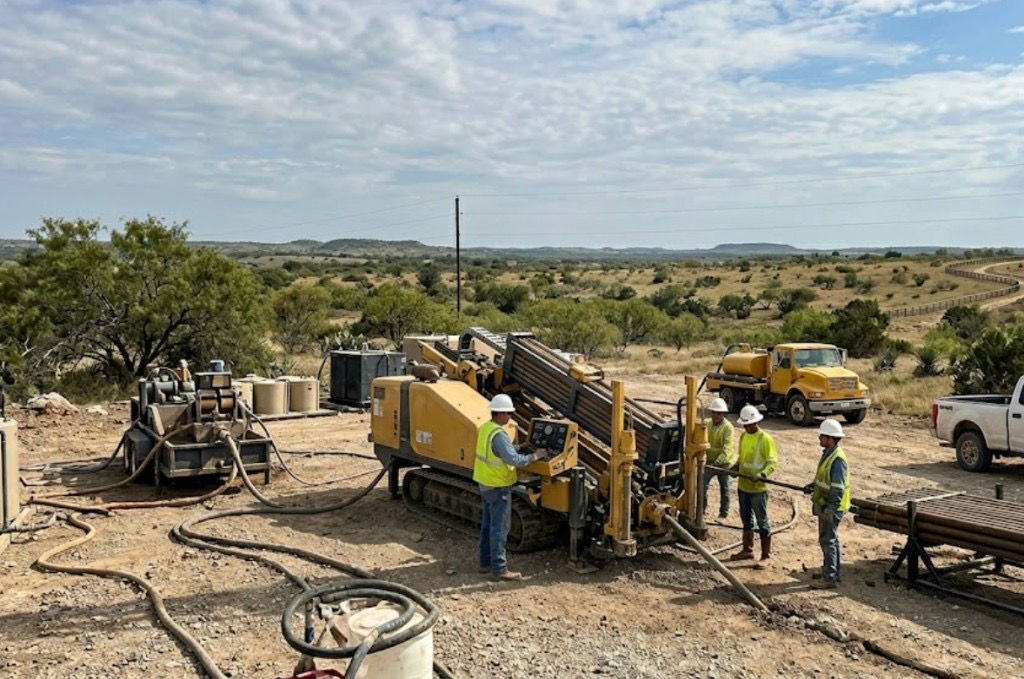
Auger boring in El Paso fits straight drives where owner or agency spec requires steel casing — canal approaches, rail spurs, and warehouse loading lanes near Santa Teresa. Drive pits are shored for caliche and dry alluvium; spoil handling respects rock mulch and concrete match restoration.
Jack and bore holds line and grade on a fixed push — valuable when IBWC or railroad templates require documented casing before carriers enter. Directional Boring Texas scopes jacking force, pit depth, and caliche wear for El Paso alignments before quoting windows.
Real El Paso County angles — not generic statewide copy.
Railroad agreements and casing wall spec gate calendar months before steel moves. Jack and bore from shored pits pushes casing while flagging windows are honored.
Municipal storm near levee infrastructure needs casing protecting RCP from scour. Straight auger drives avoid stripping flood-control restoration open-cut would require — IBWC review may apply.
Industrial expansions require casing under future loading lanes before concrete is placed. Compact jack pits push steel while forklift access still exists.
TxDOT approach slabs on I-10 and US-54 frontage roads spec casing for certain crossings. Auger bore minimizes full-width pavement removal in desert wind exposure.
Shored drive and reception pits account for caliche crust and dry alluvium. Casing segments jack forward while spoil is removed. Survey holds line and grade; carriers grout per spec. Arroyo-adjacent pits pause when monsoon wash risk is high.
Desert alluvium, cemented caliche, and bedrock ridges dominate — very different from Gulf clay metros.
El Paso County bores encounter dry alluvium, cemented caliche, and bedrock ridges. Fluid loss behaves differently in arid soils — mud must carry cuttings without excessive water loss into fractures. Caliche can accelerate bit wear; production rates reflect that. Rocky entries on westside slopes need rig anchoring and pullback planning for grade. Do not assume Gulf Coast clay rules apply — Far West Texas jobs are priced and scheduled on local ground.
Desert heat, monsoon bursts, and wide daily temperature swings affect crew scheduling and concrete/asphalt restoration timing.
Summer heat above 100°F shifts crew hours and hydration protocols. Monsoon bursts in July–September can flood low-lying pits in Mission Valley. Winter temperature swings still freeze exposed pipes occasionally — emergency calls spike after cold snaps.
City of El Paso Engineering, El Paso County, TxDOT El Paso District, IBWC adjacency near Rio Grande levees, Fort Bliss coordination.
City of El Paso Engineering permits ROW work. El Paso County governs unincorporated areas. TxDOT El Paso District handles I-10 and US-54 crossings. IBWC and levee authorities may review bores near Rio Grande flood control structures. Fort Bliss engineering coordinates on-base and adjacent segments.
Jack and bore avoids stripping full pavement on moderate straight crossings. HDD wins on curved arroyo alignments. Near levee ROW, method follows agency template.
Casing diameter, drive length, pit depth, soil type, shoring, dewatering, traffic control, and rail or highway permit fees.
We review plans, bore path, access, existing utilities, and owner goals — residential repair or engineered crossing.
Texas dig law compliance: ticket, wait period, verify marks, pothole at conflicts before steel or bit enters ground.
Alignment, profile, soil expectations, permit needs, and crossing agreements for roads, rails, or waterways.
Right rig for length and diameter — mini-HDD for tight urban shots, larger spreads for long pulls and reams.
Steerable pilot, survey checks, reaming passes as required for product pipe or casing diameter.
HDPE fusion, steel casing, conduit bundles, or carrier pipe installed per spec with pullback monitoring.
Alignment records, mandrel or pressure tests where spec requires, as-built for owners and inspectors.
Minimal surface disturbance philosophy — compact entry/exit pits, restore hardscape and landscape per scope.
Straight casing under rail or levee templates favor jack and bore. Curved paths or long HDPE pulls favor HDD.
Yes when railroad agreements, casing spec, and locate windows align.
Depth follows casing diameter and shoring — cemented caliche extends pit time significantly.
Steel casing from 12 inch through 72 inch and larger on engineered canal and highway crossings.
Yes — pit excavation exposes El Paso Electric, EP Water, gas, and telecom.
24/7 — Emergency dispatch statewide. Tell us your bore path, pipe size, and city — a specialist calls or texts back with a straight answer.
Free bore estimate
Step 1 of 2 — project details first