Casing under a BNSF spur near downtown
Railroad agreements and casing wall spec gate calendar months before steel moves. Jack and bore from shored pits pushes casing while flagging windows are honored.
Fort Worth, TX · Tarrant County
Jack-and-bore casing under Fort Worth rail spurs, Trinity levees, and straight industrial crossings — rigid steel where Tarrant agency specs demand it.
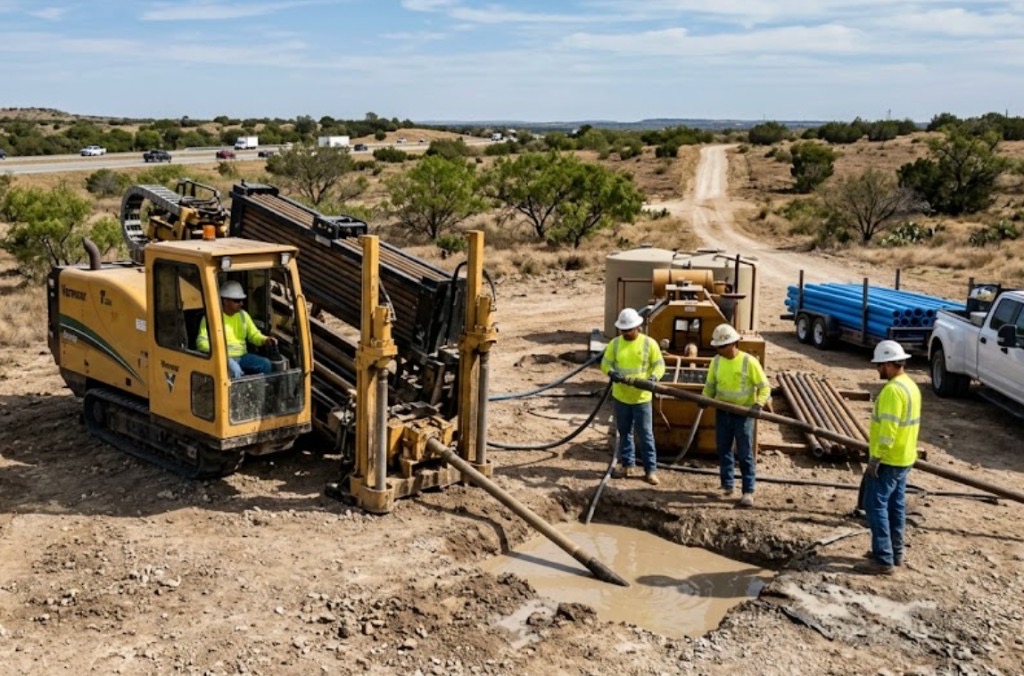
Auger boring in Fort Worth fits straight drives where owner or agency spec requires steel casing — BNSF spurs, Trinity levee approaches, and warehouse loading lanes at Alliance. Drive pits are shored for clay, limestone stringers, and alluvium; spoil handling respects brick street and granite curb restoration.
Jack and bore holds line and grade on a fixed push — valuable when railroad templates require documented casing before carriers enter. Directional Boring Texas scopes jacking force, pit depth, and dewatering for Tarrant alignments before quoting windows.
Real Tarrant County angles — not generic statewide copy.
Railroad agreements and casing wall spec gate calendar months before steel moves. Jack and bore from shored pits pushes casing while flagging windows are honored.
Municipal storm near floodway needs casing protecting RCP from scour. Straight auger drives avoid stripping riparian restoration open-cut would require — environmental windows apply.
Warehouse expansions require casing under future loading lanes before asphalt is placed. Compact jack pits push steel while forklift access still exists.
TxDOT approach slabs on I-35W and Chisholm Trail Parkway spec casing for certain crossings. Auger bore minimizes full-width pavement removal.
Shored drive and reception pits account for clay, limestone, and alluvium. Casing segments jack forward while spoil is removed. Survey holds line and grade; carriers grout per spec. Trinity-adjacent pits may need dewatering — scoped in estimate.
Bend Arch clay and limestone stringers, legacy Barnett shale influence on pad sites, and Trinity River alluvium near floodways.
Fort Worth profiles mix expansive clay with limestone ledges and occasional shale. Trinity floodway soils are looser and wetter — dewatering may be required. North side caliche and limestone stringers slow production if unplanned. Alliance area cuts may expose shallow rock favorable for stable bores but abrasive on tooling. We set ream and pullback plans per entry geotech when provided.
Tornado-season thunderstorms, hail, and dry-line wind events affect Fort Worth ROW safety and restoration scheduling.
Spring tornado and hail season pauses crews when lightning threatens open ROW. Summer heat limits asphalt patch windows. Trinity flood events can delay creek-adjacent work for days after upstream rain.
City of Fort Worth Transportation & Public Works, Tarrant County, TxDOT Fort Worth District, and BNSF rail coordination.
City of Fort Worth issues ROW permits and drive cut approvals. Tarrant County handles unincorporated pockets. TxDOT Fort Worth District covers I-35W, I-30, Loop 820, and Chisholm Trail Parkway crossings. BNSF agreements govern many rail bores — lead times vary by crossing class. Trinity River environmental windows may restrict timing near levees and wetlands.
Jack and bore avoids stripping full pavement on moderate straight crossings. HDD wins on curved Trinity alignments. In Stockyards brick ROW, method follows agency template.
Casing diameter, drive length, pit depth, soil type, shoring, dewatering, traffic control, and rail or highway permit fees.
We review plans, bore path, access, existing utilities, and owner goals — residential repair or engineered crossing.
Texas dig law compliance: ticket, wait period, verify marks, pothole at conflicts before steel or bit enters ground.
Alignment, profile, soil expectations, permit needs, and crossing agreements for roads, rails, or waterways.
Right rig for length and diameter — mini-HDD for tight urban shots, larger spreads for long pulls and reams.
Steerable pilot, survey checks, reaming passes as required for product pipe or casing diameter.
HDPE fusion, steel casing, conduit bundles, or carrier pipe installed per spec with pullback monitoring.
Alignment records, mandrel or pressure tests where spec requires, as-built for owners and inspectors.
Minimal surface disturbance philosophy — compact entry/exit pits, restore hardscape and landscape per scope.
Straight casing under rail or levee templates favor jack and bore. Curved paths or long HDPE pulls favor HDD.
Yes when railroad agreements, casing spec, and locate windows align.
Depth follows casing diameter and shoring — caliche extends pit time on Alliance pads.
Steel casing from 12 inch through 72 inch and larger on engineered crossings.
Yes — pit excavation exposes Oncor, Atmos, Fort Worth Water, and telecom.
24/7 — Emergency dispatch statewide. Tell us your bore path, pipe size, and city — a specialist calls or texts back with a straight answer.
Free bore estimate
Step 1 of 2 — project details first