
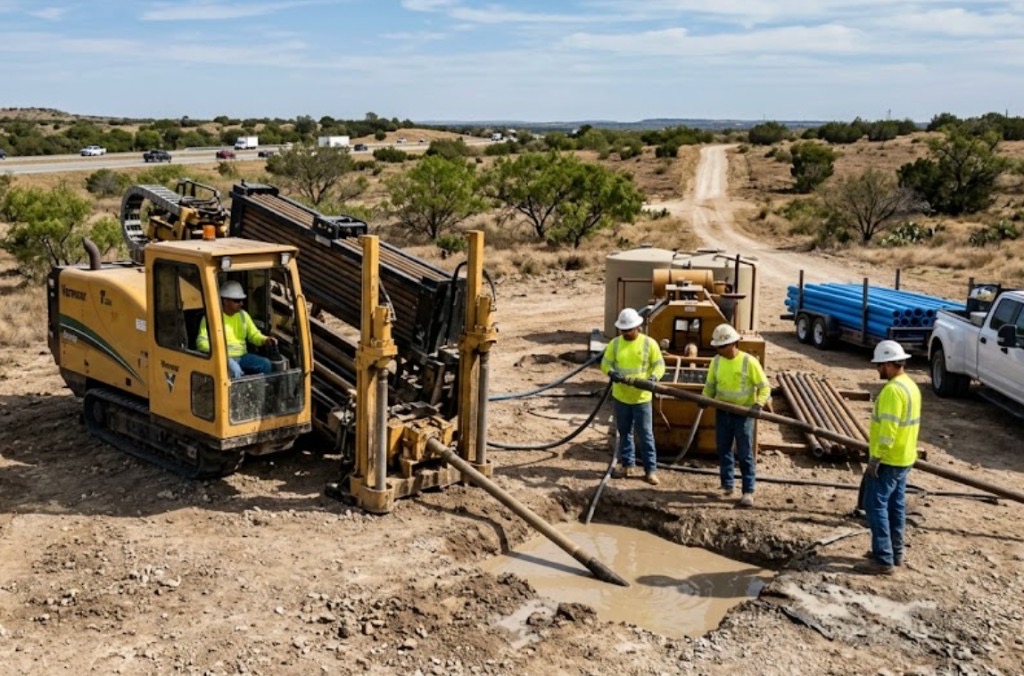
Sewer lateral under an east Garland ranch-home drive
1970s–80s PVC failures under split-level and ranch homes need compact pit strategy. Steerable bore from cleanout to tap replaces failed pipe with HDPE while limiting yard disturbance.
Garland, TX · Dallas County
Sewer and water line boring under east Garland drives, Hubbard shoreline lots, and aging PVC lateral replacements — HDPE pulls without trenching tight yards.
Sewer and water line boring in Garland is what east Garland and lake-adjacent homeowners search when PVC laterals fail under drives and side yards too narrow for trench machines. Firewheel property managers need repeat TI bores; shoreline lots carry buoyancy-aware pullback planning.
Garland utilities lead service replacements and main-to-lateral ties along Broadway and Belt Line corridors use the same trenchless pull where ROW limits surface work. Directional Boring Texas coordinates tap timing, HDPE sizing, and 811 locates across Oncor, Atmos, and irrigation before pits open.
Real Dallas County angles — not generic statewide copy.
1970s–80s PVC failures under split-level and ranch homes need compact pit strategy. Steerable bore from cleanout to tap replaces failed pipe with HDPE while limiting yard disturbance.
Older housing stock with fenced side yards leaves no room for trench equipment. Entry at meter preserves drive — homeowners avoid weeks of restoration.
Municipal crews replacing mains near the lake face alluvium and higher groundwater. Trenchless sections reduce shoreline disturbance while tying into manholes — dewatering scoped when required.
Narrow alleys too tight for trench boxes. Compact rigs replace laterals under brick with minimal closure.
Cleanout or meter pit is entry; city tap or house connection is exit. Pilot steers under hardscape; ream matches HDPE OD; pullback monitored for buoyancy near Hubbard-adjacent lots. Sprinkler systems potholed at tie-ins.
Blackland clay with Austin Chalk toward the west, softer alluvium near the lake — dual personality soils in one city.
Garland profiles shift from blackland clay inland to softer alluvium near Ray Hubbard and creeks. Clay needs frac-out control; alluvium needs collapse prevention with careful ream pacing. Austin Chalk stringers appear west toward Richardson border. Lake-adjacent bores may require dewatering. We do not use one soil model for the whole city.
Metroplex hail, thunderstorms, and lake-effect humidity near Ray Hubbard influence Garland boring and restoration timing.
Spring hail delays restoration. Lake-adjacent humidity after storms softens entries. Summer heat restricts asphalt work on south Garland arterials.
City of Garland Engineering, Dallas County, TxDOT Dallas District on I-635 and I-30, and lake shoreline ROW sensitivity.
City of Garland Engineering permits ROW work. Dallas County handles pockets outside limits. TxDOT Dallas District governs I-635 and I-30 crossings. Lake shoreline and creek alignments may trigger additional environmental sensitivity — share maps early.
Open-cut destroys east Garland lawns and Firewheel-sensitive landscapes. Boring wins on residential lateral replacement across Garland.
Length, depth, pipe material, surface restoration, city tap fees, rock, and access for rig setup.
We review plans, bore path, access, existing utilities, and owner goals — residential repair or engineered crossing.
Texas dig law compliance: ticket, wait period, verify marks, pothole at conflicts before steel or bit enters ground.
Alignment, profile, soil expectations, permit needs, and crossing agreements for roads, rails, or waterways.
Right rig for length and diameter — mini-HDD for tight urban shots, larger spreads for long pulls and reams.
Steerable pilot, survey checks, reaming passes as required for product pipe or casing diameter.
HDPE fusion, steel casing, conduit bundles, or carrier pipe installed per spec with pullback monitoring.
Alignment records, mandrel or pressure tests where spec requires, as-built for owners and inspectors.
Minimal surface disturbance philosophy — compact entry/exit pits, restore hardscape and landscape per scope.
Often yes — bore under hardscape from offset pits. Some tie-ins need small access cuts.
Yes — compact pits and steering under the slab are routine on tight lots.
Yes — common for residential replacement per city requirements.
Yes — pit stability, dewatering, and buoyancy monitoring may apply. Scoped upfront.
Length, shoreline groundwater, hardscape, tap fees, and utility congestion drive price.
24/7 — Emergency dispatch statewide. Tell us your bore path, pipe size, and city — a specialist calls or texts back with a straight answer.
Free bore estimate
Step 1 of 2 — project details first