Duct bank under Epic Central SH-360 paving
Post-paving TI on completed asphalt cannot trench across retail pads to reach switchgear. HDD links vaults under pavers with traffic control on 360 growth corridor feeders.
Grand Prairie, TX · Dallas County
Steerable HDD through Epic Central SH-360 paving, Joe Pool lakefront groundwater, and Trinity greenbelt crossings — Grand Prairie directional drilling with mid-cities Dallas County soils and HOA hardscape restoration.
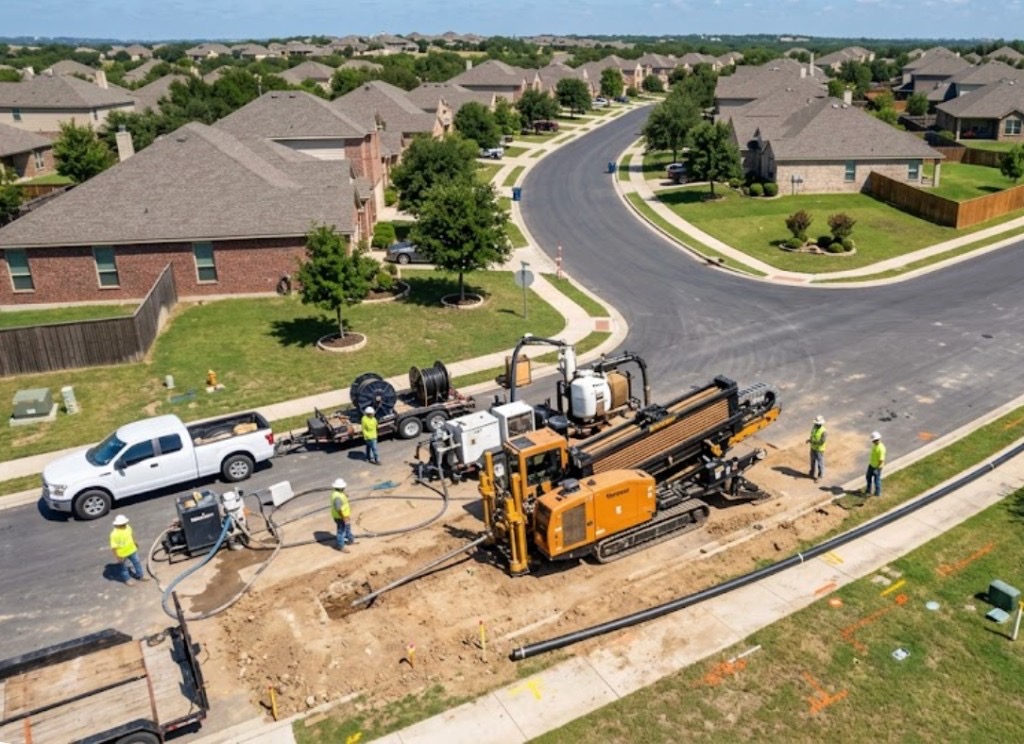
Horizontal directional drilling in Grand Prairie spans Epic Central SH-360 commercial growth, Joe Pool lakefront groundwater, and Trinity greenbelt crossings. GP Lakes homeowners save pool decks when laterals fail; GCs hit tenant dates on I-20 logistics yards after paving is down without cutting newly placed asphalt.
Grand Prairie sits between Dallas, Arlington, Irving, and Fort Worth — I-20, I-30, SH-360, and Belt Line feed industrial parks, lakefront neighborhoods, and Epic Central redevelopment at once. Directional Boring Texas tickets Texas 811, quotes Joe Pool groundwater staging upfront, and plans Trinity greenbelt environmental windows before pits open.
Real Dallas County angles — not generic statewide copy.
Post-paving TI on completed asphalt cannot trench across retail pads to reach switchgear. HDD links vaults under pavers with traffic control on 360 growth corridor feeders.
Lakefront HOAs scrutinize hardscape restoration. Steerable bore from cleanout to Grand Prairie utilities tap preserves stamped concrete and pool decks with compact pits.
TxDOT Dallas District relocations stack under mid-cities ROW. HDD narrows closure footprint — industrial MOT scoped upfront on Belt Line paths.
Lake-adjacent lots carry higher groundwater and alluvium. Fluid programs and pit shoring differ from inland chalk profiles — buoyancy monitored on pullback.
Grand Prairie crews walk alignment with Oncor and city utility maps. Trinity alluvium may need dewatering; chalk toward Arlington slows reaming. Pilot, ream, and pullback monitored for buoyancy near Joe Pool. Greenbelt environmental windows gate mobilization when alignments require.
Trinity River alluvium near the greenbelt, Austin Chalk and expansive blackland clay on higher benches — profiles shift quickly across Grand Prairie.
Grand Prairie profiles range from Trinity alluvium near the river and Joe Pool tributaries to Austin Chalk and expansive blackland clay on higher ground. Alluvium is looser and wetter — dewatering and pit stability matter. Chalk and limestone stringers west toward Arlington slow reaming if unplanned. Lake-adjacent cuts encounter higher groundwater that affects buoyancy on HDPE pulls. Mid-cities Dallas County geology is scoped per alignment, not per marketing zip code.
North Texas thunderstorms, hail, and summer heat affect Grand Prairie pit stability; Joe Pool and Trinity adjacency adds groundwater and seasonal saturation risk.
Spring hail and thunderstorms pause outdoor crews when lightning threatens. Trinity and Joe Pool flood events after upstream rain can delay greenbelt-adjacent entries. Summer heat limits asphalt and paver restoration windows. Winter freezes are shorter than Panhandle events but still spike pipe break calls.
City of Grand Prairie Engineering, Dallas County, TxDOT Dallas District on I-20 and SH-360, and Joe Pool / lakefront HOA restoration standards.
City of Grand Prairie Engineering permits ROW occupancy and bore notifications. Dallas County handles unincorporated pockets. TxDOT Dallas District governs I-20, I-30, and SH-360 crossings. Joe Pool lakefront and master-planned communities may impose landscape and hardscape restoration standards beyond city minimums. Trinity greenbelt alignments may need environmental review depending on proximity to the channel.
Open-cut through GP Lakes hardscape and Epic Central parking destroys HOA-standard landscape faster than the bore costs. HDD wins on lakefront residential and SH-360 commercial TI.
Length, diameter, soil/rock, groundwater, traffic control, permit fees, number of utilities in corridor, night work, and rig class drive estimates — not a single per-foot rate.
We review plans, bore path, access, existing utilities, and owner goals — residential repair or engineered crossing.
Texas dig law compliance: ticket, wait period, verify marks, pothole at conflicts before steel or bit enters ground.
Alignment, profile, soil expectations, permit needs, and crossing agreements for roads, rails, or waterways.
Right rig for length and diameter — mini-HDD for tight urban shots, larger spreads for long pulls and reams.
Steerable pilot, survey checks, reaming passes as required for product pipe or casing diameter.
HDPE fusion, steel casing, conduit bundles, or carrier pipe installed per spec with pullback monitoring.
Alignment records, mandrel or pressure tests where spec requires, as-built for owners and inspectors.
Minimal surface disturbance philosophy — compact entry/exit pits, restore hardscape and landscape per scope.
Length, Joe Pool groundwater, alluvium dewatering, TxDOT permits, HOA restoration, and duct count drive estimates.
Yes — commercial duct banks and water service under paving are common scope.
Higher groundwater and lake-adjacent soils change shoring and pullback planning. Seasonal saturation may shift schedule.
Yes — compact pits offset from the driveway and HDD under the slab are routine.
Curved alignments favor HDD; straight casing under freeway or greenbelt templates may favor jack and bore.
24/7 — Emergency dispatch statewide. Tell us your bore path, pipe size, and city — a specialist calls or texts back with a straight answer.
Free bore estimate
Step 1 of 2 — project details first