Duct bank under Legacy West granite curbs
Post-paving TI under granite curbs and association-approved pavers cannot trench across campus drives. HDD links vaults under asphalt with restoration colors matched to master-plan standards.
Plano, TX · Collin County
Steerable HDD through Collin blackland clay, Legacy West granite, and US-75 DART adjacency — Plano directional drilling with HOA restoration standards and master-planned hardscape discipline.
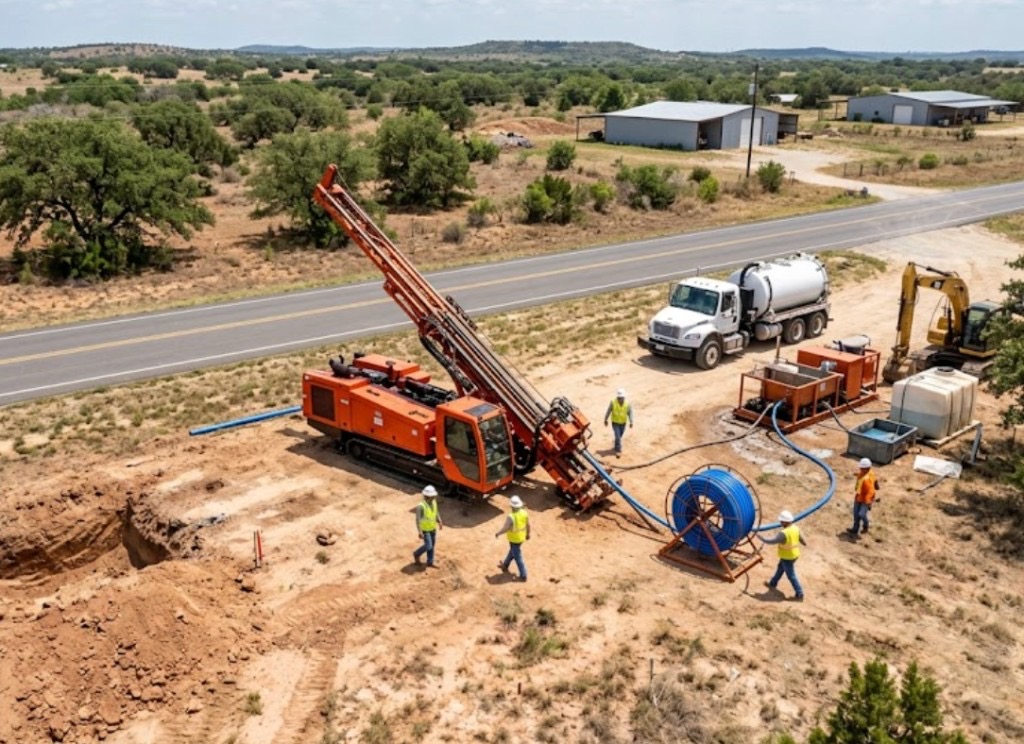
Horizontal directional drilling in Plano spans Legacy West granite curbs, Shops at Legacy pavers, and Collin County blackland in older east Plano blocks. West Plano HOAs expect trenchless sewer under pool decks with landscape bond awareness; corporate GCs at Granite Park bore duct bank under parking that cannot close for open trenching.
Plano is not a single soil model — west side chalk stringers and east side aging PVC laterals need different production assumptions. Directional Boring Texas tickets Texas 811, coordinates DART engineering on US-75 alignments, and quotes TxDOT lead time on highway relocations before pits open.
Real Collin County angles — not generic statewide copy.
Post-paving TI under granite curbs and association-approved pavers cannot trench across campus drives. HDD links vaults under asphalt with restoration colors matched to master-plan standards.
1980s PVC fails under pool decks and sport courts in Preston Meadow and Willow Bend. Steerable bore from cleanout to city tap preserves Bermuda lawns HOAs scrutinize.
TxDOT Dallas District relocations stack under north Plano ROW. HDD narrows closure footprint — DART coordination added when Red Line influence applies.
Corporate campuses need vault-to-vault shots under paved quadrangles. Private utility owner approval beyond 811 scoped in pre-mobilization checklists.
Plano crews walk alignment with Oncor and city utility maps on congested Preston intersections. Entry pits are compact for HOA landscape bonds; mud programs manage expansive clay frac-out risk toward storm drains. West Plano chalk stringers may slow ream stages — production assumptions are Collin-local.
Blackland prairie clay with Austin Chalk stringers and shallow rock on west Plano — expansive soils that reward trenchless over repeated open-cut restoration.
Plano subsurface is dominated by expansive blackland clay with limestone and chalk stringers increasing toward the west. Clay favors controlled mud weight to limit frac-outs toward storm drains. Shallow rock can stabilize holes but wears reamers faster — estimates reflect that when neighbor experience or geotech suggests rock. Sandy pockets near creeks are rare but change fluid loss behavior. We review city as-builts and Oncor maps on congested intersections before setting pullback plans.
North Texas hail and thunderstorm season, summer heat, and occasional ice events shape Plano boring schedules and asphalt restoration windows.
Spring hail can pause outdoor work for safety. Summer heat limits asphalt patch compaction windows. Winter ice drives emergency water line calls — frozen soil slows pit work but rarely stops HDD once pits are open and locates are valid.
City of Plano Engineering, Collin County, TxDOT Dallas District on US-75 and SH-121, and DART Red Line adjacency on east Plano corridors.
City of Plano Engineering permits ROW occupancy, drive cuts, and bore notifications. Collin County handles pockets outside city limits. TxDOT Dallas District governs US-75 and state highway crossings. DART coordination applies near Red Line corridors. Legacy and corporate campuses may add private utility owner approval beyond 811 — we scope that in pre-mobilization checklists.
Open-cut through Legacy pavers and west Plano lawns destroys hardscape and triggers HOA restoration fights faster than the bore costs. HDD wins on master-planned lots and corporate TI.
Length, diameter, soil/rock, groundwater, traffic control, permit fees, number of utilities in corridor, night work, and rig class drive estimates — not a single per-foot rate.
We review plans, bore path, access, existing utilities, and owner goals — residential repair or engineered crossing.
Texas dig law compliance: ticket, wait period, verify marks, pothole at conflicts before steel or bit enters ground.
Alignment, profile, soil expectations, permit needs, and crossing agreements for roads, rails, or waterways.
Right rig for length and diameter — mini-HDD for tight urban shots, larger spreads for long pulls and reams.
Steerable pilot, survey checks, reaming passes as required for product pipe or casing diameter.
HDPE fusion, steel casing, conduit bundles, or carrier pipe installed per spec with pullback monitoring.
Alignment records, mandrel or pressure tests where spec requires, as-built for owners and inspectors.
Minimal surface disturbance philosophy — compact entry/exit pits, restore hardscape and landscape per scope.
Length, chalk intervals, HOA restoration, DART coordination, TxDOT permits, and duct count drive estimates — not a flat per-foot rate.
Expansive blackland clay needs mud discipline to avoid frac-outs. Rock stringers west of Preston may slow reaming.
Yes with DART engineering coordination on US-75 corridor alignments.
Yes — duct banks, water service, and fiber under paved lots are core Plano work.
Curved alignments favor HDD; straight casing under rail or highway templates may favor jack and bore.
24/7 — Emergency dispatch statewide. Tell us your bore path, pipe size, and city — a specialist calls or texts back with a straight answer.
Free bore estimate
Step 1 of 2 — project details first